CONTENT
Lakehouse architecture in Microsoft Fabric
Lakehouse architecture enables organisations to structure and manage data across its lifecycle - from landing raw data from source systems, through cleansing and transformation, to creating trusted, analytics-ready datasets for reporting, planning and AI.


Jackie Tejwani
Director - Business Intelligence
What is a Microsoft Fabric Lakehouse?
Microsoft Fabric Lakehouse is a modern data architecture that combines the flexibility of a data lake with the structure and analytical capabilities of a traditional data warehouse.
Within Microsoft Fabric, the Lakehouse allows organisations to ingest, store, transform and analyse data in a single unified environment. Data can be loaded from multiple source systems, refined through different transformation stages, and then made available for semantic models, Power BI and AI agents
One of the key benefits of the Fabric Lakehouse is that it is built on Microsoft OneLake, providing a single logical data lake across the organisation. This helps reduce data duplication and gives teams a consistent platform for data engineering, analytics and business intelligence.
Medallion Architecture
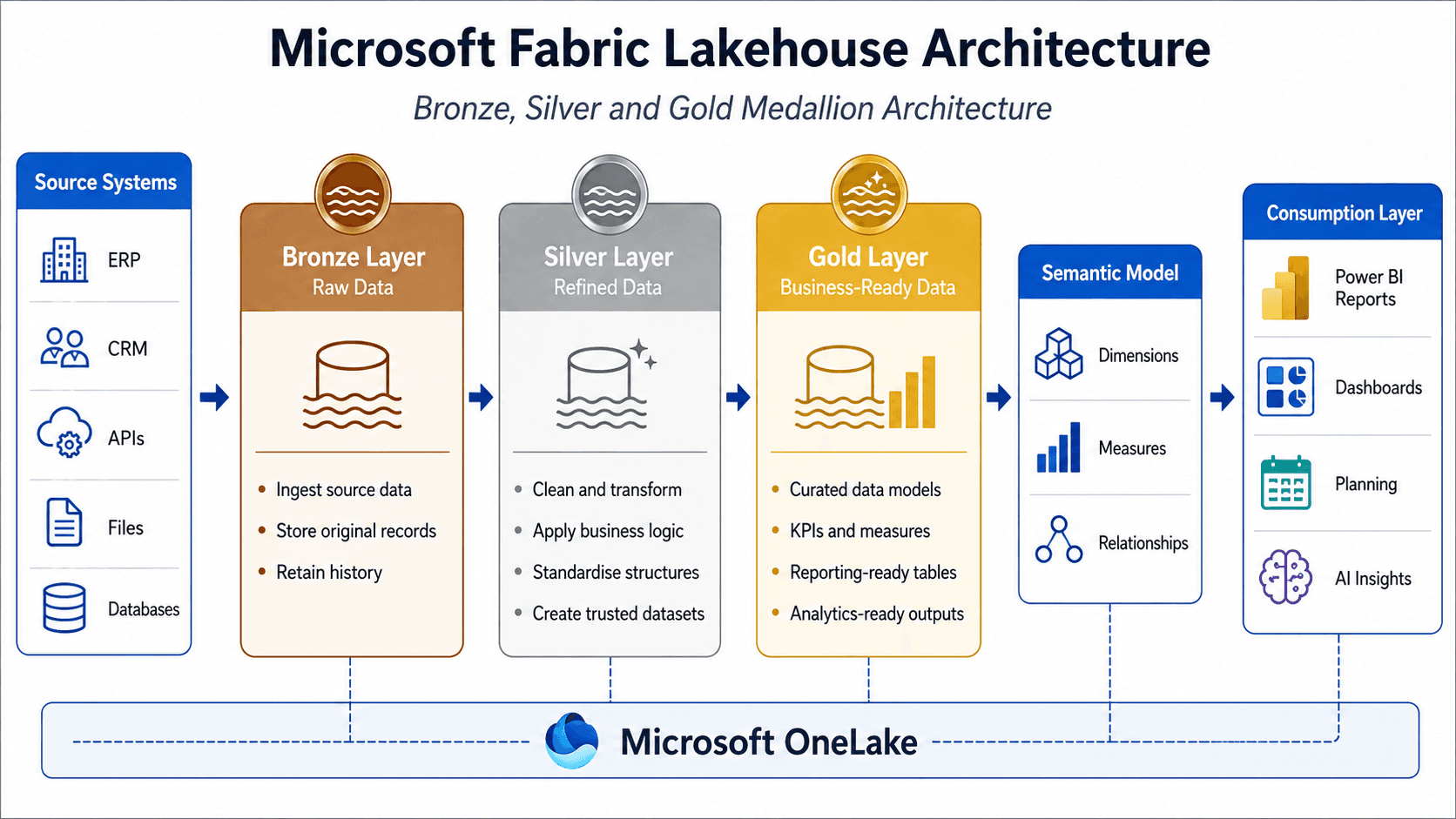
A common approach when implementing a Microsoft Fabric Lakehouse is the Medallion Architecture, where data is organised into Bronze, Silver and Gold layers.
Bronze – Raw Data
Bronze layer is usually where the data is landed from source systems such as ERP platforms, CRM systems, APIs, databases, spreadsheets and cloud applications.
The goal of the Bronze layer is to retain a reliable copy of the source data before major transformations are applied.
Typical examples include:
API extracts
Database tables
CSV and Excel files
JSON data
Application and transactional data
Keeping raw data provides traceability and makes it easier to reprocess historical data if business logic changes.
Silver – Refined Data
The Silver layer is where raw data is cleaned, standardised and transformed using business logic to create trusted, analysis-ready datasets
Typical transformations can include:
Removing duplicates
Correcting data types
Standardising field names
Handling missing values
Joining related datasets
Applying business rules
Creating common dimensions and keys
The Silver layer provides a trusted and consistent version of the data that can be reused across multiple reporting and analytical workloads.
Gold – Business-Ready Data
The Gold layer contains curated data that has been prepared specifically for business reporting, analysis and AI.
At this stage, data is typically organised around business concepts such as:
Revenue
Customers
Products
Finance
Operations
Sales
Budget and forecast
Key performance indicators
The Gold layer can then feed Power BI semantic models, dashboards, planning applications and AI solutions.
This separation between raw, refined and business-ready data makes the architecture easier to manage, govern and scale.
Why Use a Lakehouse in Microsoft Fabric?
A Microsoft Fabric Lakehouse provides several advantages over managing multiple disconnected data platforms.
It enables organisations to centralise their data while supporting data engineering, analytics, reporting and AI within the same ecosystem.
Key benefits include:
Single source of truth across reporting and analytics
Reduced data duplication through OneLake
Scalable data transformation using Fabric notebooks, pipelines and dataflows
Native integration with Power BI
Support for structured and unstructured data
Improved data governance and lineage
Faster development of analytics and AI solutions
Reusable datasets across multiple business teams
For organisations currently relying on spreadsheets or multiple disconnected reporting systems, a Lakehouse architecture can provide a more robust foundation for enterprise analytics.
What is a Microsoft Fabric Lakehouse?
Microsoft Fabric Lakehouse is a modern data architecture that combines the flexibility of a data lake with the structure and analytical capabilities of a traditional data warehouse.
Within Microsoft Fabric, the Lakehouse allows organisations to ingest, store, transform and analyse data in a single unified environment. Data can be loaded from multiple source systems, refined through different transformation stages, and then made available for semantic models, Power BI and AI agents
One of the key benefits of the Fabric Lakehouse is that it is built on Microsoft OneLake, providing a single logical data lake across the organisation. This helps reduce data duplication and gives teams a consistent platform for data engineering, analytics and business intelligence.
Medallion Architecture
A common approach when implementing a Microsoft Fabric Lakehouse is the Medallion Architecture, where data is organised into Bronze, Silver and Gold layers.
Bronze – Raw Data
Bronze layer is usually where the data is landed from source systems such as ERP platforms, CRM systems, APIs, databases, spreadsheets and cloud applications.
The goal of the Bronze layer is to retain a reliable copy of the source data before major transformations are applied.
Typical examples include:
API extracts
Database tables
CSV and Excel files
JSON data
Application and transactional data
Keeping raw data provides traceability and makes it easier to reprocess historical data if business logic changes.
Silver – Refined Data
The Silver layer is where raw data is cleaned, standardised and transformed using business logic to create trusted, analysis-ready datasets
Typical transformations can include:
Removing duplicates
Correcting data types
Standardising field names
Handling missing values
Joining related datasets
Applying business rules
Creating common dimensions and keys
The Silver layer provides a trusted and consistent version of the data that can be reused across multiple reporting and analytical workloads.
Gold – Business-Ready Data
The Gold layer contains curated data that has been prepared specifically for business reporting, analysis and AI.
At this stage, data is typically organised around business concepts such as:
Revenue
Customers
Products
Finance
Operations
Sales
Budget and forecast
Key performance indicators
The Gold layer can then feed Power BI semantic models, dashboards, planning applications and AI solutions.
This separation between raw, refined and business-ready data makes the architecture easier to manage, govern and scale.
Why Use a Lakehouse in Microsoft Fabric?
A Microsoft Fabric Lakehouse provides several advantages over managing multiple disconnected data platforms.
It enables organisations to centralise their data while supporting data engineering, analytics, reporting and AI within the same ecosystem.
Key benefits include:
Single source of truth across reporting and analytics
Reduced data duplication through OneLake
Scalable data transformation using Fabric notebooks, pipelines and dataflows
Native integration with Power BI
Support for structured and unstructured data
Improved data governance and lineage
Faster development of analytics and AI solutions
Reusable datasets across multiple business teams
For organisations currently relying on spreadsheets or multiple disconnected reporting systems, a Lakehouse architecture can provide a more robust foundation for enterprise analytics.
CONTENT
SHARE